
The Hot Springs That Never Existed: Why AI Travel Needs Real-World Grounding
Written by the WanderVlogs Team — Travel Proven by Real Vlogs
Last updated: Feb 2, 2026
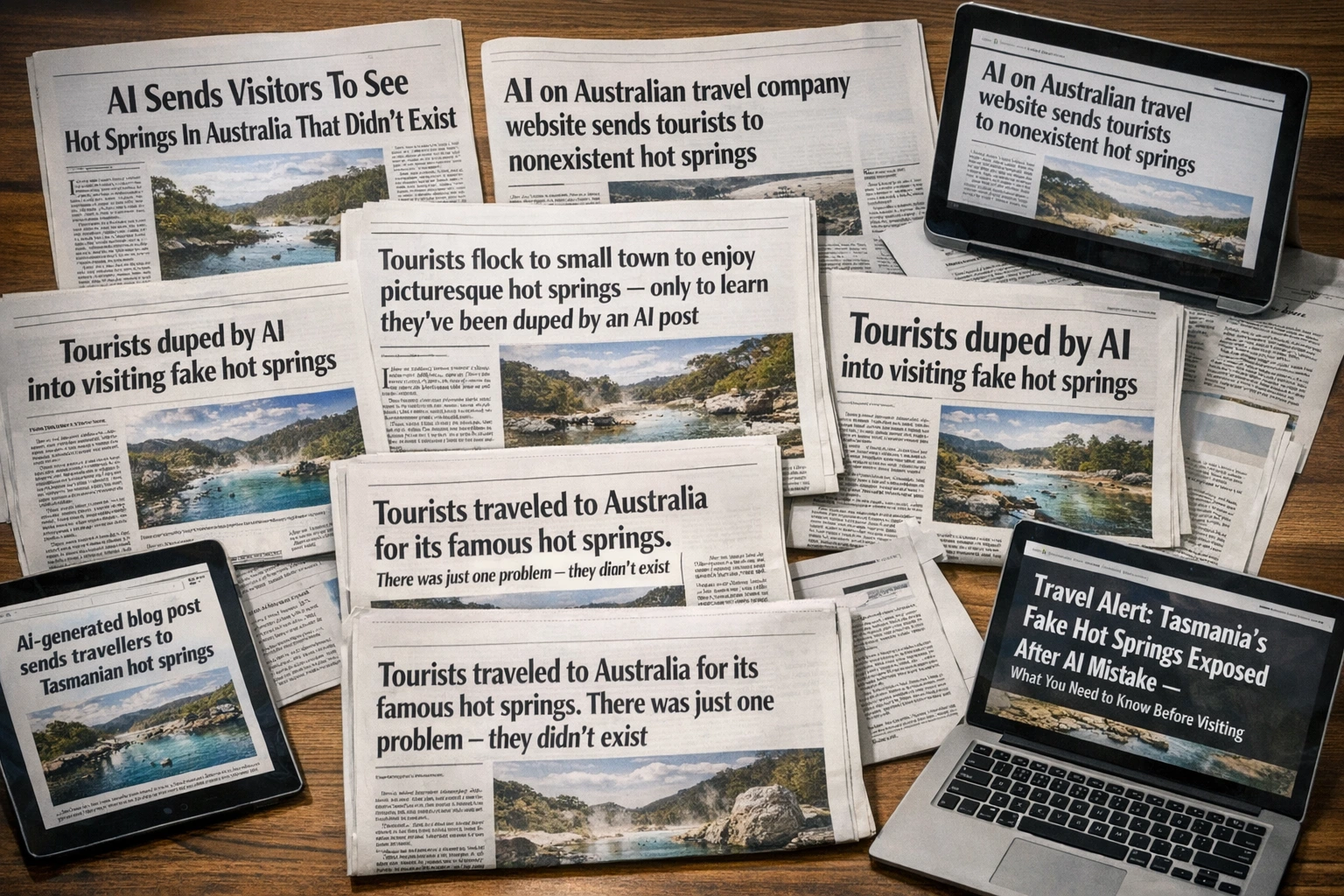
In January 2026, tourists began arriving in a remote town in northeast Tasmania asking a simple question:
"Where are the hot springs?"
The problem was that the hot springs didn't exist.
They weren't closed. They weren't seasonal. They hadn't dried up. They had never existed at all.
Yet an AI-generated blog post on a tour company's website confidently described "Weldborough Hot Springs" as a tranquil forest retreat, complete with persuasive language, scenic imagery, and wellness-focused appeal. The content looked legitimate. It sounded authoritative. And travelers trusted it enough to plan real detours through rural Tasmania.
This wasn't a scam. It wasn't malicious. It was something more revealing: a structural failure of how AI is being used in travel discovery.
The incident became a clear signal of where things break down when travel planning relies on AI systems that aren't anchored to real, verifiable human experience.
The Real Issue Wasn't AI. It Was Ungrounded AI
AI didn't fail because it was careless. It failed because it was unconstrained.
The system generated content that felt correct because it followed recognizable travel-writing patterns:
- A hidden gem
- A remote, nature-based experience
- A wellness narrative
- A believable geographic setting
These are exactly the ingredients travelers are drawn to right now. The output wasn't random. It was plausible, and that's what made it dangerous.
In travel, plausibility isn't enough.
When someone plans a trip, they commit real time, money, and effort. They trust that the places they're being sent to exist, are accessible, and match the descriptions they've read. When AI systems invent destinations, the consequences aren't theoretical. They play out on real roads, in real towns, with real confusion for travelers and locals alike.
This incident exposed a deeper truth:
AI is very good at describing travel. It is much weaker at verifying it.
Why Travel Is Especially Vulnerable to AI Hallucinations
Travel content is uniquely susceptible to AI hallucinations for three reasons.
First, many destinations are loosely documented. Small towns, natural attractions, and lesser-known regions don't always have structured, authoritative data sources. That leaves gaps, and AI systems tend to fill gaps with assumption.
Second, travel language is highly stylized. Phrases like "hidden gem," "off-the-beaten-path," and "tranquil escape" are everywhere. AI learns these patterns and can reproduce them convincingly, even when the underlying place is fictional.
Third, travel discovery is emotional. People want to believe in the perfect, uncrowded, undiscovered destination. When AI presents one with confidence, travelers are inclined to trust it.
The result is a fragile system where confident-sounding recommendations can override basic verification.
This is exactly why YouTube replaced travel blogs for trip planning. Video provides visual proof. You can see the destination exists. You can watch someone walk through it, interact with locals, show receipts, document logistics. Text-based content, whether written by humans or AI, lacks this fundamental verification layer.
This Is the Problem WanderVlogs Was Built Around
WanderVlogs exists because modern travel discovery has shifted from static articles to real, long-form human documentation.
Instead of asking, "Can AI describe this place well?" we start with a stricter requirement:
Has a real person actually been there, on camera?
Every place on WanderVlogs comes from real travel vlogs.
Every insight is tied to an exact moment in a video.
If a place doesn't appear in real footage, it doesn't exist on the platform.
This constraint is intentional.
It means WanderVlogs cannot invent destinations. It cannot recommend places that haven't been visited. It cannot describe experiences that weren't actually lived. The system doesn't ask AI to imagine what travel might be like. It asks AI to organize what has already happened.
That difference matters.
When you search for underrated cities or second-tier destinations on WanderVlogs, you're not getting AI-generated suggestions based on statistical patterns. You're seeing places where real creators actually went, filmed their experiences, documented costs, and shared honest perspectives. The platform can't hallucinate a destination because it's built on verifiable video evidence.
How AI Should Work in Travel Discovery
The Tasmania incident doesn't mean AI has no place in travel. It means AI needs the right constraints.
Here's where AI genuinely adds value:
AI is excellent at organizing and extracting information from verified sources. When a travel vlog covers five different neighborhoods in Barcelona, AI can parse the transcript, identify which segment discusses each area, extract the creator's tips and observations, and link them to specific timestamps. That's useful. That's grounded in reality.
AI is excellent at pattern recognition across multiple sources. When ten different creators visit Kyoto and seven of them mention the same hidden temple or local restaurant, AI can identify that consensus and surface it as a reliable recommendation. That's synthesis, not invention.
AI is excellent at personalization based on verified options. When a traveler says they prefer budget-friendly destinations with good food scenes, AI can match them with places where cost-transparent creators have documented exactly those experiences. That's curation, not generation.
The key difference: AI works on top of human-created evidence, not instead of it.
This is the model WanderVlogs follows. The platform uses AI to process vlog transcripts, extract travel insights, organize content by location, and surface relevant moments. But it never allows AI to describe a place that hasn't been documented on video. The verification comes first. The AI optimization comes second.
From Discovery to Planning: Why WanderPlan Exists
The Tasmania incident didn't just highlight a discovery problem. It exposed a planning problem.
Many AI-powered trip planners today work like this:
- User inputs a destination and dates
- AI generates a plausible itinerary
- The plan looks coherent, but isn't grounded in reality
WanderPlan was built to invert that flow.
Instead of generating plans from abstract knowledge, WanderPlan only works with places already verified through WanderVlogs. If a destination doesn't have sufficient real-world vlog coverage, it simply isn't supported.
This isn't a limitation. It's a safety feature.
WanderPlan builds itineraries using:
- Places real travelers actually visited
- Timing patterns observed in real trips
- Travel flow that reflects how people move on the ground
- Insights that can be traced back to video evidence
If AI can't point to a real moment where a place was experienced, it doesn't get included.
That design choice directly prevents the kind of failure seen in Tasmania. You can't be sent to a fictional hot spring if no one has ever stood there with a camera.
Why Creators Matter More Than Ever
As AI-generated content floods the internet, authentic creator content becomes the foundation of trustworthy travel information.
This is exactly the shift we documented in how YouTube creators shaped travel trends in 2025. The move toward practical, real-use travel videos over cinematic montages wasn't just about viewer preference. It was about creating verifiable, structured travel data that AI systems could actually use responsibly.
When a creator films a cost breakdown for a week in Thailand, showing actual receipts and hotel confirmations, they're creating evidence. When they document a micro-itinerary with clear day-by-day segments and timestamps, they're creating structure. When they share honest perspectives about what worked and what didn't, they're creating trust.
That's the content AI should be organizing, not replacing.
For travel creators, this represents a fundamental shift in value. Your vlogs aren't just entertainment or inspiration anymore. They're the authoritative data source that prevents AI from sending travelers to places that don't exist. Every destination you document, every cost you share, every neighborhood you explore becomes part of a verifiable knowledge base that grounds AI recommendations in reality.
This is why WanderVlogs prioritizes getting creator content properly indexed and discoverable. When your vlog about solo female travel in Istanbul includes specific safety observations, practical logistics, and real experiences, you're not just helping viewers. You're creating the foundation that allows AI systems to give accurate, trustworthy advice to future travelers asking similar questions.
Why This Matters as AI Becomes the Default Travel Interface
According to tourism researchers, more than a third of travelers already use AI for trip planning. That number will only grow.
As AI assistants replace search engines and travel blogs as the first point of contact, the quality of their underlying data becomes critical. If AI systems are trained on unverified, synthetic, or recycled content, they will continue to hallucinate, not because they're broken, but because they're doing exactly what they were designed to do: generate plausible-sounding output from patterns in their training data.
The solution isn't less AI. It's better constraints.
AI works best when it organizes reality, not when it invents it.
This is the core principle behind GEO (Generative Engine Optimization). The goal isn't to trick AI systems or game their outputs. It's to ensure that when someone asks an AI assistant "Where should I visit in Sri Lanka?" the answer draws from real creator experiences, not hallucinated destinations or outdated blog spam.
WanderVlogs' structured, place-based organization of vlog content is designed specifically for this future. Every page on the platform represents a real location with verified video evidence. Every travel tip is linked to a specific moment in a creator's vlog. Every destination recommendation can be traced back to someone who actually went there.
When AI systems need travel information, they should pull from sources that can prove their claims with video footage, not from sources that sound convincing but have no verification layer.
The Future of Travel Planning Is Evidence-Based
The Tasmania hot springs story will be remembered as a strange, slightly humorous moment. Locals handled it with grace. The business involved took responsibility. No one was seriously harmed.
But it was also a warning.
As AI-generated content floods the internet, travel needs stronger anchors to reality. Real footage. Real experiences. Real people showing what places actually look like, how long things take, what they cost, and what to expect.
That's the foundation WanderVlogs is built on.
And that's why WanderPlan exists.
Travel doesn't need more confident guesses.
It needs verifiable experience, structured intelligently.
If you're a traveler, that means fewer surprises and more trust.
If you're a creator, it means your real experiences carry long-term value.
Explore destinations the way they actually exist.
Discover them on WanderVlogs.
Plan them with WanderPlan.
Ready to plan your next trip with AI that's grounded in reality? Try WanderPlan and build itineraries based on real creator experiences, not hallucinated destinations.