
Why Getting the Right Viewers Matters More Than Getting More Views
Written by the WanderVlogs Team — Travel Proven by Real Vlogs
Last updated: Jan 13, 2026
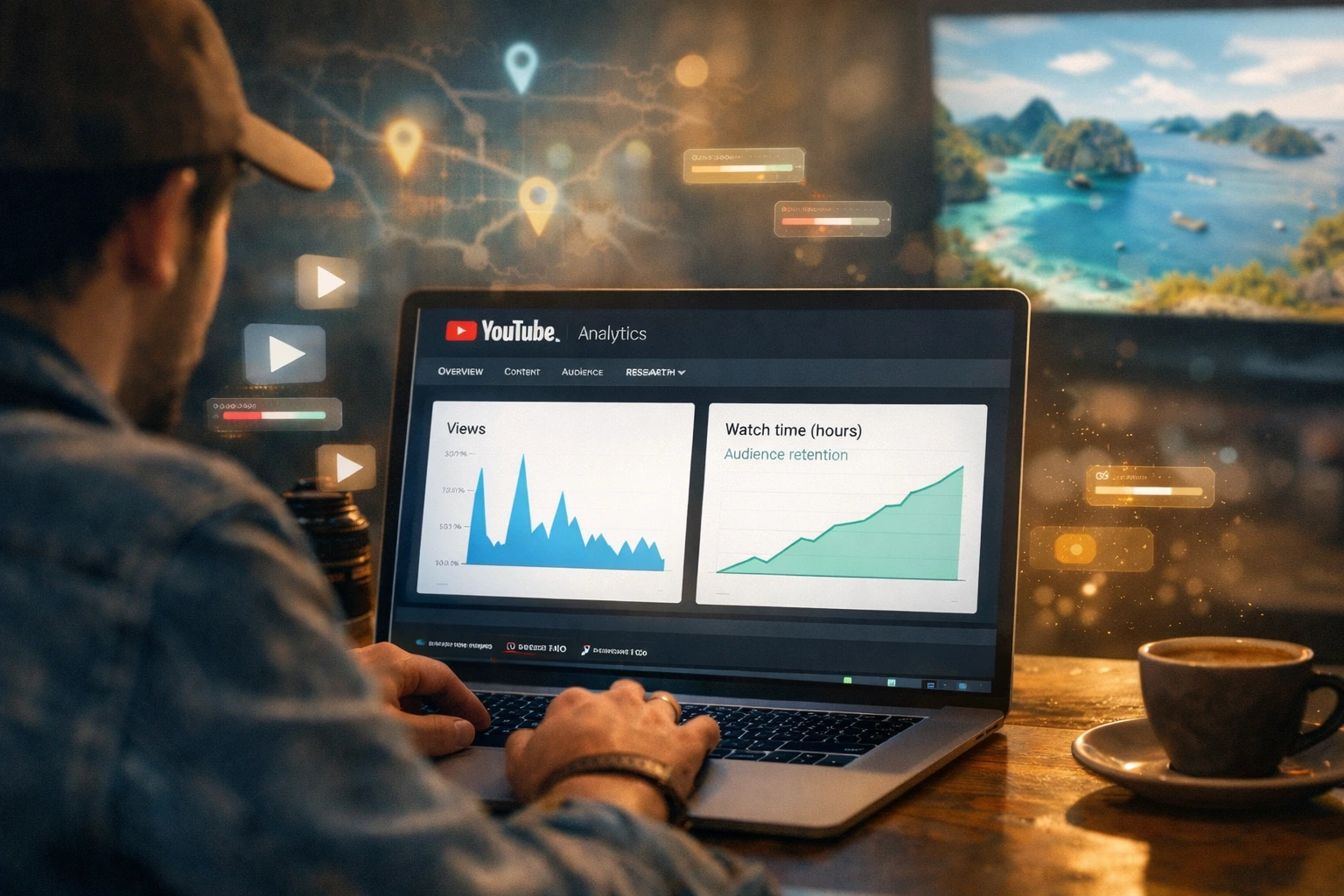
The Question Every Travel Creator Asks
You've heard it a hundred times: "Focus on watch time, not views." Or maybe it's the opposite: "Views are what matter for growth, retention comes later."
Every YouTube strategy guide, every creator advice video, every analytics breakdown seems to land on one side of this debate. Either you're chasing views to feed the algorithm, or you're obsessing over watch time percentages to prove your content resonates.
For travel creators, this question feels especially urgent. Your vlogs take weeks to produce. You're filming across multiple locations, editing hours of footage into coherent stories, trying to balance cinematic moments with practical information. When that video finally goes live and the metrics start coming in, you want to know: what should I actually be optimizing for?
Here's the truth that most advice misses: it's a false choice.
Views and watch time aren't competing priorities. They're symptoms of the same underlying problem, and for travel creators specifically, that problem runs deeper than thumbnails, titles, or editing techniques.
The real issue is this: your content is reaching the wrong viewers at the wrong moments. And until you fix that fundamental mismatch, no amount of metric optimization will solve your growth problem.
What YouTube Really Cares About
Let's cut through the noise and be direct about how YouTube's system actually works.
Views tell YouTube your content can attract attention. When someone clicks on your video, that's a signal. It means your thumbnail worked, your title was compelling, or the algorithm surfaced your content to someone who decided it was worth trying.
Watch time tells YouTube people stayed. It's the measure of whether that initial click translated into genuine engagement. If someone watches two minutes of your 20-minute vlog and leaves, YouTube learns that the video didn't deliver on whatever promise convinced them to click.
Neither metric alone tells the full story. A video with massive views but terrible retention signals that you're good at getting clicks but bad at keeping attention. A video with incredible watch time but few views suggests you're creating something valuable for a small audience but can't break through to new viewers.
Growth happens when both metrics align. When the people clicking your videos are the same people who want to watch them all the way through. When your content reaches viewers who are genuinely searching for what you're offering, not just scrolling past and clicking on impulse.
For travel creators, this alignment is especially difficult to achieve on YouTube alone. And understanding why requires looking at how travel content actually performs on the platform.
Why Travel Videos Lose on Both Metrics
Here's the fundamental problem with travel vlogs on YouTube: your best content is hidden inside your videos, and the platform treats the entire thing as a single unit.
Let's say you've created a comprehensive vlog covering your week in Italy. Over 25 minutes, you explore Rome, sample wine in Tuscany, wander through Venice, and hike the Cinque Terre coastline. Each segment is valuable. Each destination has its own story, tips, and visual moments that travelers searching for that specific place would love to see.
But YouTube indexes it as one video: "Italy Travel Vlog."
This creates three problems that directly impact your metrics:
First, your great moments stay hidden. Someone searching for "best views in Cinque Terre" won't find your video, even though you covered exactly that topic at minute 18. Your authentic experience with that destination never reaches the people actively looking for it.
Second, the wrong viewers find your video. YouTube's algorithm might surface your Italy vlog to someone vaguely interested in European travel, but they're really planning a trip to Spain. They click out of curiosity, watch three minutes, and leave. That's a view, but it's a negative signal for watch time.
Third, even the right viewers struggle to engage properly. Someone genuinely planning a trip to Venice might find your video through search. But when they arrive, they have to scrub through 25 minutes trying to find the Venice segment. Many won't bother. They'll click away, hurting your retention metrics despite being exactly the audience you want.
The result: low retention signals and weak engagement, not because your content is bad, but because discovery is broken.
Your video reaches people who aren't interested, while missing the people who are. And when the right people do find it, the format makes it difficult for them to extract the value they came for.
No amount of thumbnail testing or title optimization fixes this structural mismatch. Because the problem isn't how you're packaging your content. It's how YouTube discovers and surfaces it in the first place.
The Real Fix: Better Discovery, Not Better Thumbnails
Here's the shift that changes everything: you don't grow by gaming metrics. You grow by getting the right viewers to the right moments.
Think about what actually happens when a travel vlog succeeds on YouTube. It's not because the creator cracked some secret thumbnail formula or figured out the perfect title length. It's because the video reached people who genuinely wanted to see that content, at the exact moment they were searching for it.
When someone planning a trip to Kyoto searches "things to do in Kyoto" and finds your vlog covering exactly that city, they watch. They engage. They comment, save the video, maybe even subscribe. That's aligned discovery. The viewer's intent matches your content, so both views and watch time naturally follow.
The problem is that YouTube can't consistently create this alignment for travel content, especially when your vlogs cover multiple destinations. The platform's discovery system wasn't built to parse and index individual locations within longer videos.
This is where WanderVlogs fundamentally changes the equation.
Instead of treating your 25-minute Italy vlog as a single unit competing in YouTube's general algorithm, WanderVlogs breaks it down into structured, place-based segments. Every destination you mention gets extracted, timestamped, and organized into a searchable hierarchy: country, city, specific place.
When discovery is organized by location instead of algorithm, both your views and watch time improve. Because the people finding your content are the people actively searching for the places you've covered. And when they arrive, they can jump directly to the moment they care about.
This isn't about abandoning YouTube or fighting the algorithm. It's about creating additional pathways for the right viewers to discover your content, pathways that YouTube's system simply can't provide on its own.
How WanderVlogs Solves Both Problems at Once
Place-based discovery fixes views and watch time simultaneously because it addresses the root cause: misaligned expectations between what viewers want and what they actually find.
More views from the right people. When you upload a vlog covering Rome, Florence, and Venice, WanderVlogs creates three separate discovery opportunities. Someone searching for Florence-specific content finds your vlog through that city's page. Someone researching Venice finds you through a completely different path. One video, multiple discovery points. On YouTube, that same vlog only appears when someone searches for general Italy content. Most of your specific destinations stay invisible.
Better watch time from satisfied viewers. When someone discovers your content on WanderVlogs, they land with clear expectations. If they found your video through the Rome page, they know before clicking that the video covers Rome. No bait-and-switch, no mismatched expectations. They can jump directly to the timestamp covering the destination they care about, watch those minutes with full attention, and often continue watching related sections because the experience delivered value.
This might seem counterintuitive. Doesn't letting people skip ahead hurt watch time? Actually, the opposite happens. When viewers can immediately access what they're looking for, satisfaction increases. And satisfied viewers keep watching. Think about your own behavior as a consumer. When you search for information and have to hunt through a long video to find it, you're frustrated. You might give up entirely. But when you land exactly where you need to be, you're more likely to explore, rewatch, and engage with surrounding content.
Intent-driven traffic that compounds over time. Unlike YouTube's algorithm, which gives most videos a brief 48-hour window to prove themselves, WanderVlogs creates evergreen visibility. Your vlog about hiking trails in Ella from six months ago remains discoverable every single time someone searches for that destination. Views don't spike and die. They accumulate steadily as long as travelers keep searching for those places.
The difference is fundamental. YouTube can deliver millions of impressions, but if those impressions go to people who aren't interested in travel, your metrics suffer. WanderVlogs delivers fewer but far more targeted views from people genuinely looking for what you've created. Travel-only audience, search intent that matches your content, and direct access to relevant moments. That's how both metrics improve together.
From Viral Chasing to Long-Term Growth
Let's talk about what sustainable growth actually looks like for travel creators.
On YouTube, growth often feels like a lottery. You upload a video, cross your fingers, and hope the algorithm picks it up in the first 48 hours. If it gains early traction, great. If not, it disappears into your archive, rarely seen again. This creates a cycle of constant content production just to stay visible, because yesterday's video is already losing relevance.
WanderVlogs operates on a fundamentally different timeline. Your content doesn't expire after two days. It becomes part of an evergreen library organized by location. That vlog you posted six months ago about Santorini remains just as discoverable today as the day you uploaded it, because travelers don't stop planning trips to Santorini.
This shift changes how you think about content creation. Instead of chasing viral moments or trending topics, you're building a portfolio of authentic travel experiences that compound in value over time. Every destination you document becomes a permanent asset, continuously attracting new viewers as long as people search for those places.
Metrics stop being stressful and start compounding. On YouTube, a "failed" video (one that didn't gain immediate traction) feels like wasted effort. On WanderVlogs, there's no such thing as a failed video. Every vlog covering real destinations contributes to your discoverability. The more places you document, the more entry points travelers have to find your content.
Over months and years, this approach builds momentum that viral chasing never can. You're not dependent on algorithm luck or trending challenges. You're creating a searchable map of your travel experiences, and every new video makes that map more comprehensive and valuable.
For creators tired of the constant pressure to perform within narrow algorithmic windows, this model offers something different: growth through consistency and authenticity, not viral gambles.
Stop Choosing Between Reach and Depth
The choice between optimizing for views or watch time was always the wrong question.
What actually matters is whether your content reaches people who genuinely want to see it. When discovery works properly, when the right viewers find the right moments at the right time, both metrics improve naturally. You don't have to sacrifice one for the other.
YouTube's algorithm tries to solve this problem through engagement signals, recommendations, and search ranking. And it works reasonably well for many content types. But for travel vlogs covering multiple destinations, the platform's one-video-one-ranking model creates fundamental limitations.
WanderVlogs doesn't replace YouTube. It amplifies it. Your videos stay on YouTube, your audience stays on YouTube, your channel continues growing on YouTube. But now your content has additional discovery pathways designed specifically for how travelers actually search: by location, not by creator popularity or algorithmic recommendation.
This is about expanding your reach to the people who are already looking for what you've created but can't find it through YouTube's system alone. It's about making sure that when someone searches for travel content about Barcelona, Bali, or Bangkok, your authentic experience shows up, not just the most popular creator or the most clickable thumbnail.
Your travel content represents real experiences, genuine insights, and countless hours of work. It deserves to reach travelers who are actively searching for exactly what you've documented. Not through viral luck or algorithm manipulation, but through clear, place-based discovery that connects authentic stories with people who genuinely want to find them.
That's the mission of WanderVlogs: making your content discoverable by the travelers who need it most, organized by the places you've actually explored, built for long-term growth instead of short-term viral chasing.
Ready to make your travel content more discoverable? Join WanderVlogs and start connecting with viewers who are genuinely searching for the destinations you've covered.
Because at the end of the day, success isn't about getting more views or higher watch time. It's about reaching the right people with the right content at the right moment. And when that happens, everything else follows.