
The Rise of Search Pages for Travel Videos
Written by the WanderVlogs Team — Travel Proven by Real Vlogs
Last updated: Mar 13, 2026
The Hidden Limitation of Travel Vlogs
Imagine you've just finished editing your latest travel vlog.
You spent weeks filming sunrise over the temples of Kyoto, wandering through quiet alleyways, tasting street food at a local night market, and sharing honest tips about what surprised you most during the trip. After hours of editing, color grading, and storytelling, you finally upload the video to YouTube.
For a few days, maybe a few weeks, it performs well. Views come in. Comments appear. The algorithm pushes it to some new viewers.
Then gradually, things slow down.
Not because your video stopped being valuable. Not because travelers stopped planning trips to Kyoto.
But because YouTube's discovery system has moved on to newer uploads.
For most travel creators, this pattern is familiar. Your videos experience an initial spike in visibility, then slowly fade into the background as the algorithm prioritizes fresh content.
Yet the places you documented, the insights you shared, and the experiences you captured are still highly relevant to travelers planning trips months or even years later.
The real problem isn't the quality of your content.
The problem is how travel videos are discovered on the internet.
How Travelers Actually Search for Travel Content
Think about how people plan trips.
They rarely start by searching for a specific YouTube creator. Instead, they search for destinations and questions about places:
These searches usually happen in Google, AI assistants, or travel planning tools, not inside YouTube.
This is where a structural imbalance appears.
Travel blogs dominate these searches because they produce structured web pages built around destinations. Each blog post becomes a page optimized for search engines: clear headings, organized sections, FAQs, and internal links.
Travel videos, on the other hand, live inside a single platform.
A 25-minute vlog exploring Rome, Florence, and Venice may contain dozens of useful insights, but to search engines it still appears as one video file with limited structured information.
Search engines understand pages, but they struggle to interpret long-form videos.
So even when your vlog contains exactly the advice a traveler is searching for, it rarely appears in those destination searches.
The Emergence of Search Pages for Travel Videos
Travel blogs solved this problem years ago by creating destination-focused pages.
But until recently, there was no equivalent system for travel videos.
This is where a new concept is emerging: Search Pages for Travel Videos.
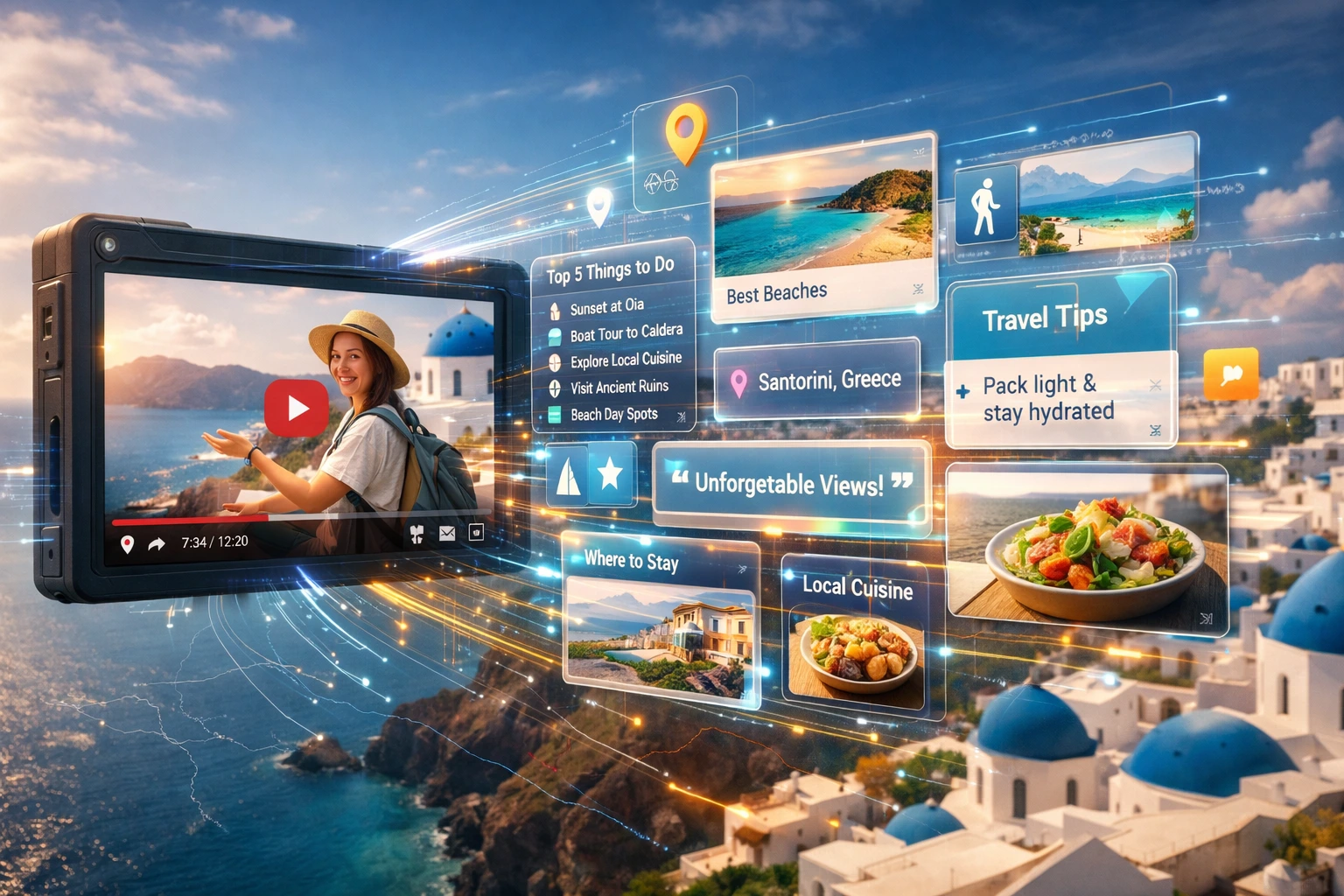
Instead of relying only on a video platform to distribute your content, the idea is to create a structured, search-friendly page built around the insights inside the video itself.
Think of it as the video equivalent of a destination guide.
Rather than writing a traditional travel blog post, the page organizes information from the vlog into structured sections such as:
- Places visited
- Activities and experiences
- Travel tips
- Highlights from the trip
- Questions travelers often ask about the destination
The video remains the core experience, but the surrounding page gives search engines and AI discovery tools the structure they need to understand the content.
In other words, your video becomes discoverable not only as a video, but as a destination page within the broader travel search ecosystem.
This shift is what makes travel videos searchable in ways that previously only blogs could achieve.
Introducing WanderBoost
This is exactly the problem WanderBoost was built to solve.
WanderBoost is a creator product built by WanderVlogs that turns your travel video into a Google-rankable destination page.
Instead of asking creators to start a blog, write articles, or learn SEO, WanderBoost automatically converts your vlog into a structured page designed for modern discovery systems.
Here's what happens when you boost a video:
- You paste your YouTube link. The system analyzes the content of your video.
- Key insights are extracted. Destinations, activities, travel tips, highlights, and common questions are identified.
- A structured destination page is created. The page organizes those insights with clear headings, internal links, and structured data designed for search engines and AI discovery systems.
Your original YouTube video remains unchanged. The page simply extends its discoverability beyond YouTube.
Instead of existing only as a video upload, your vlog becomes a searchable travel resource connected to the destinations it covers.
Why YouTube SEO Alone Isn't Enough
Many creators assume that optimizing their YouTube title, description, and tags is enough.
And while YouTube SEO helps your video perform inside YouTube, it doesn't solve the broader discovery problem.
YouTube SEO focuses on improving visibility within YouTube's recommendation and search system. But it doesn't provide strong structural signals to Google or AI search engines about the places and travel experiences inside your video.
For example, a vlog titled "Amazing 3 Days in Kyoto 🇯🇵 Travel Guide" might perform well in YouTube search. But when someone searches on Google for "best hidden temples in Kyoto," that video rarely appears among the results.
Why?
Because search engines prioritize structured web pages that clearly organize information about destinations. Without that structure, the valuable insights in your video remain difficult for search systems to interpret.
Search pages for travel videos solve this gap.
By transforming the content of a vlog into a structured destination page, the same insights become visible in the environments where travelers actually search.
Built for the Age of AI Discovery
Travel discovery isn't limited to traditional search engines anymore.
More travelers are now asking AI assistants questions like:
- "What are hidden gems in Lisbon?"
- "Where should I go for sunset views in Bali?"
- "What neighborhoods should I explore in Barcelona?"
These systems don't simply list links the way traditional search engines do. They synthesize answers from structured sources they can understand and reference.
Raw video files are difficult for these systems to parse. Structured pages, on the other hand, are exactly what AI discovery tools rely on.
Because WanderBoost pages organize your video insights into clear sections with structured data, they can be understood and referenced by both traditional search engines and modern AI systems.
This aligns with the principles of Generative Engine Optimization (GEO): making content readable not only by search engines, but also by AI-driven discovery tools.
Turning Videos Into Long-Term Discovery Assets
One of the biggest challenges for travel creators is the short lifecycle of most YouTube uploads.
A video may perform well for a short period, then slowly disappear as newer content takes its place in recommendation feeds.
But travel information doesn't expire the same way entertainment content does.
People will continue searching for sunset viewpoints in Santorini, street food in Bangkok, and hiking trails near Ella for years.
By turning your vlog into a destination page, WanderBoost allows that same video to remain discoverable whenever travelers search for those places.
Instead of relying entirely on a short algorithm window, your content becomes part of a long-term discovery system tied to real locations.
Your vlog stops being just a video.
It becomes a searchable travel resource.
A New Layer of Discovery for Travel Creators
WanderBoost doesn't replace YouTube.
Your channel, subscribers, and audience remain exactly where they are.
What WanderBoost adds is a new layer of discovery that complements the video platform. Instead of hoping travelers eventually stumble upon your video through recommendations, you give your content a presence in the places where travel discovery actually happens: search engines, AI travel assistants, and destination-based queries.
This approach represents a broader shift in how travel content is distributed online.
Travel blogs created the internet's destination pages. Now travel videos are gaining their own version: search pages for travel videos.
And for creators, that shift opens an entirely new pathway for long-term visibility.
The Future of Travel Video Discovery
The internet is evolving from a world of feeds to a world of answers.
Instead of endlessly scrolling through videos hoping to find useful information, travelers increasingly expect systems to surface relevant experiences instantly. That means discovery systems need structured, trustworthy sources.
Authentic travel creators already provide the most valuable source of travel information: real experiences captured on location. But until now, those experiences were largely trapped inside video platforms.
With tools like WanderBoost, that information becomes structured, searchable, and discoverable in the broader travel ecosystem.
Your travel vlog can now exist in two forms at once: a video story on YouTube and a destination page discoverable through Google and AI search.
And when those two worlds connect, your content doesn't just entertain viewers.
It helps travelers plan real journeys.
Want to turn your travel vlog into a Google-rankable destination page? Explore WanderBoost and start creating search pages for your travel videos today.